
Which GEOs Are Attracting Dating Affiliate Budgets in 2026?

There is an age-old playbook handed to every new affiliate who enters the dating vertical and asks, “Which GEO should I run?”
It goes: test your setup in Tier 3, take it to Tier 2 when it starts turning a profit to see if it scales and holds up, and if it does, launch in Tier 1 to start actually making money. This has been the action plan since the early 2010s, and a surprising number of dating affiliates still follow it to the letter. There is only one problem: it’s been 15 years.
The number one guideline in the playbook is that every successful campaign should eventually end up in Tier 1. The United States, the United Kingdom, Canada, Australia, and New Zealand offer the highest payouts, the largest advertiser budgets, and the strongest monetization potential. As long as you have a setup and a budget, there’s no reason to run anywhere else. Over a decade later, there are several reasons and multiple regions to branch out to.
If you are reading this after seeing sky-high CPCs for US traffic on your main ad network or noticing costs climbing all over LATAM, you are in the right place. We will break down where the money is going in 2026 and why it’s there.
Why the Tier 1 Strategy Is Becoming Outdated
The dating affiliate GEO strategy we all know was formed when Western markets offered both strong monetization and strong growth. Today, monetization is still up there, but growth might not be as strong as it used to.
According to a Financial Times analysis, major dating companies are looking increasingly toward Asia for future expansion as growth slows across parts of North America and Europe. Executives are claiming engagement dropping among younger users, swipe fatigue, and the need to find new sources of growth outside their traditional markets.
Advertisers are starting to look elsewhere for fresh user bases and bringing the budgets with them. Tier 1 dating offers can still be massively profitable, no debate there, but if you have something working well in Tier 2-3, it’s making more and more sense to scale it across the GEO.
APAC Dating GEOs Keep Gaining Volume
APAC has a rich history as sort of a proving ground for dating affiliates. The region offered high traffic volume, manageable competition, and a sizable range of dating advertisers. Most affiliate networks working in the vertical had solid dating offers for India, Thailand, Vietnam, and the Philippines. Yet affiliates always kept gunning for the US, Canada, and the UK, mainly because of the higher payouts. The prevailing view being that it’s like graduating from trading penny stocks to holding NVDA.
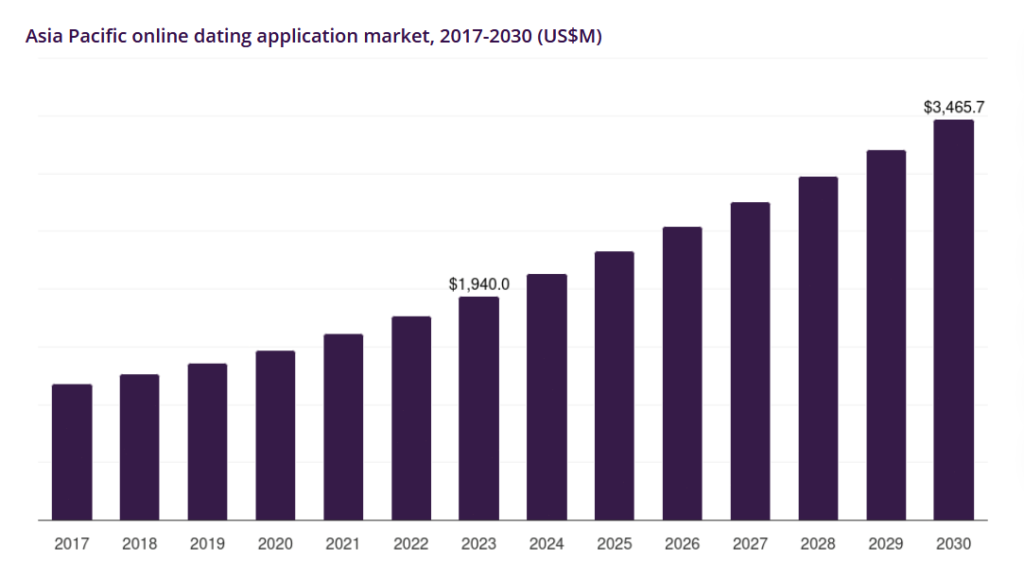
Here’s what’s happening now: a recent Grand View Research forecast predicts continued expansion across the Asia-Pacific online dating market, with India singled out as one of the region’s fastest-growing opportunities. The region already represents the largest share of the global online dating market, and the audience of potential users keeps growing thanks to the still rising internet penetration and smartphone adoption. That’s what is drawing the advertisers.
Looking for high-scale audience growth this year for similar reasons to APAC. The region combines large populations with rapidly expanding digital adoption and an overwhelmingly mobile-first user base.
A Reuters report on Latin America’s digital economy found that online commerce in the region continues to grow faster than the global average, with smartphones accounting for the overwhelming majority of purchases. Brands with mobile-first services are catching on to this indicator and allocating budgets to capture larger segments of the quickly growing prospective user base. This naturally includes dating brands.
Brazil and Mexico are still the top dating GEOs in the region, but Colombia, Peru, and Chile are increasingly appearing in executive talks around user acquisition and market expansion. For affiliates, these GEOs have always been affordable and easy to test, and now they are becoming much more scalable. When you have something that works, with room to simply buy more traffic and bring in a bigger profit, why take a chance somewhere else?
How Smartphones Make New Dating Advertisers
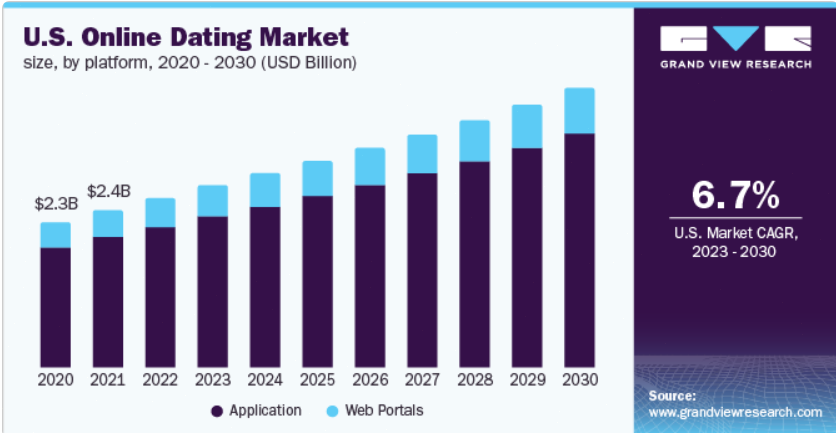
Every report about emerging GEOs eventually lands on the same explanation: more smartphones. And there are, in fact, more smartphones in APAC and LATAM than there were a decade ago. We also know that online dating is a smartphone business, recently confirmed by Grand View Research’s dating market report.
The point when a GEO moves up the food chain happens after everyone gets a smartphone. The traffic gets easier to buy and more precise to target. The platforms you’re already using suddenly have enough inventory to support real volume. Advertisers stop asking whether they can run there and start asking how much traffic is available.
A decade ago, you would test dating offers in these GEOs, learn something, make a bit of money, and move on to what was considered a more serious market. Today, these same countries are attracting attention for the opposite reason. Media buyers aren’t moving on. They’re scaling into six figures and making sure nobody gets those LATAM clicks for 2021 prices ever again.
That’s one reason the lines between GEO tiers are blurring. They were established in a world where the difference between a mature market and an emerging one was enormous. With a standardised mobile experience and global advertising infrastructure, they’ve gotten much closer.
If you’re a dating advertiser looking for your next million users, it matters a lot less whether those users are sitting in California or Jakarta than it did fifteen years ago, as long as you can reach them precisely and profitably. The Meta Ads Manager cabinet has the same interface for everyone, so the answer is yes, more often than not.
TL;DR Where Are The Dating Budgets
For years, the logic was simple:
- Tier 3 = test campaigns cheaply
- Tier 2 = validate and optimise
- Tier 1 = scale and maximise revenue
That playbook assumed three things:
- Tier 1 would always offer the best long-term opportunity.
- Emerging markets were primarily useful for gathering data.
- The differences between GEO tiers would remain substantial.
In 2026, all three can be argued against.
What’s changed?
- Growth in mature dating markets has slowed.
- Dating platforms are increasingly looking to Asia and Latin America for new users. Affiliates have noticed.
- Mobile adoption and standardization has made many emerging GEOs easier to reach and monetise.
- Advertisers are willing to commit larger budgets outside traditional Tier 1 markets.
- Some former “testing GEOs” are now viable for long-term scaling.
The old question:
How quickly can I move this campaign to Tier 1?
The new question:
How far can I scale it with the same ROI?
Nobody is saying dating’s largest markets are dying. The United States, the United Kingdom, Canada, and Australia will remain major destinations for dating traffic for years to come. The fact is that several other destinations are becoming major in 2026.
The six-figure campaign dream is still alive. It’s just available in a few more languages now.